
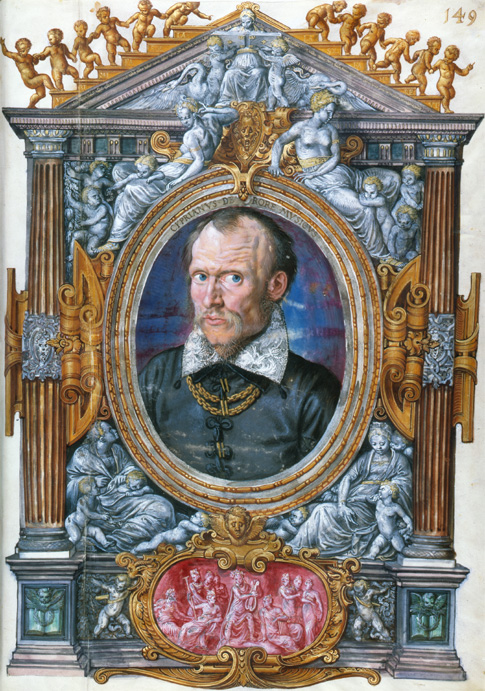
Cipriano de Rore. Have you heard of him? He’s not topping the popularity charts, but it’s worth finding his music. And please forgive the terrible pun. I have been surrounded by both the music of de Rore, and posters of Finding Dory for a while and there was an inevitability about the title of this post. As it happens, my daughter and I found her and her family at Toronto’s aquarium earlier this month, so that’s all good.
I’d very much like to wish de Rore a very Happy-500-year-Birthday, but the exact date is a bit sketchy. In fact, a number of details of his life are a bit sketchy. But we know that de Rore was big business in the 16th century and so when Radio 3 wanted to make a show in celebration of him, I decided it was best to let the music do the talking. And wow it can talk. In sound, he’s a link man between Josquin des Prez and Claudio Monteverdi and like fellow Low Countries man Josquin, he wound up in Ferrara at the service of the d’Este family. It turned out that De Rore could turn his hand to writing rather fabulously in both the old academic style (prima pratica), and the new-fangled emotive style (seconda pratica). This made him versatile and garnered him a stellar reputation.
But as a man, he lurks in the shadows of history. After a bit of digging around, and a good read of the Grove article, I fired off some emails to scholars and performers to try to find out some gossip. And there lies a bit of a brick wall. Leading de Rore scholar Professor Katelijne Schiltz, a member of the Musicology Department at the University of Regensburg, is co-author of a new biography of the composer which will be released later this year and her passion for his music is both inspirational and incredibly insightful. She directed me to the most beautiful and monumental codex in the Bavarian State Library (shelfmark Mus.ms. B), which has recently been digitised and contains 26 motets by Cipriano, with illuminations by Hans Mielich (http://daten.digitale-sammlungen.de/~db/0010/bsb00103729/images/). It’s an incredible manuscript, commissioned by Duke Albrecht V of Bavaria. But any exciting, or even boring, anecdotes? No, not really. He quit his job at St Marks, Venice because it was a bit chaotic and the pay was miserable. So we find the man through the music and as you will hear on the Early Music Show, both Katelijne and Dr Stephen Rice of the Brabant Ensemble recommend some stunning works.
Finding de Rore was for me a journey of discovery into the 16th-century world of innovation in polyphonic sacred writing and madrigalian frolics – and a real joining of the dots between better-known composers of the age. There is such beauty and poise in his writing and some cracking recordings from The Tallis Scholars, Huelgas Ensemble, and Brabant Ensemble. But his music is a rich seam waiting to be found by many more musicians. And a word on my pronunciation of Cipriano or Cypriaan. I went for SIPriano rather than CHIPriano, on account of his being Flemish. I’ll have to hope he doesn’t mind if that’s not how he pronounced it, I’m sure he’d be chuffed to little mint balls that we are devoting a show to him. Happy Birthday il divino Cipriano.
De Rore on the Early Music Show aired on 7 August, to hear the celebration of his life and music download the podcast from the Radio3 website.

 Where does the uttered music go?