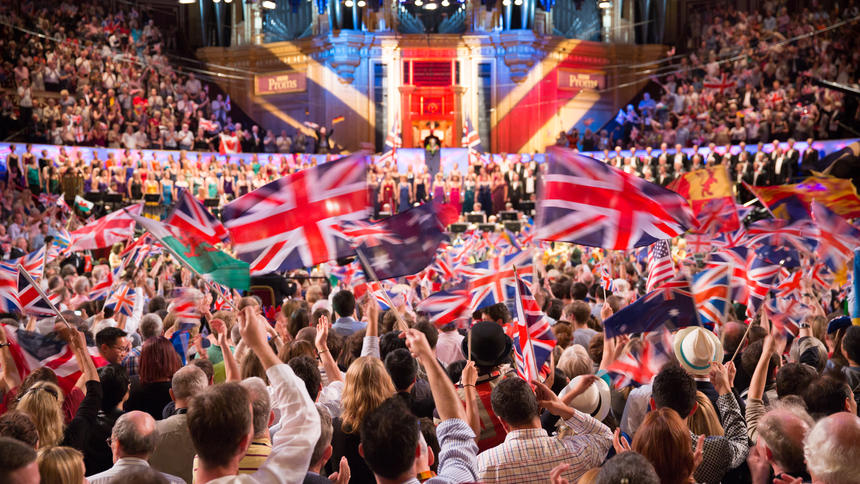
We just celebrated our first Canada Day as a family in Toronto. We dressed up in so much Canadiana we were a vision in red, white, and maple – and out here that’s cool. If you did the same with the Union Flag, I’m not sure you would capture the same tone, certainly not right now. Which leads me to thinking about the most flag-waving event in my British calendar: The Last Night of the Proms. For many years it has trodden a bit of a fine line in nationalistic taste, but I fear for the evening in a post-Brexit referendum year.
The thought of it leaves me feeling a bit queasy, especially as earlier this year I wrote a feature for the night’s Proms Guide on Parry’s Jerusalem. It’s 100 years since Parry set Blake’s poem but I’m not convinced that there’s much ‘green and pleasant’ going on across the land just now.
For consolation I’ve had a look back to Henry Wood’s Last Night. Yes, the whole Prom season was always an intense expression of Englishness (not even necessarily Britishness) – the National Anthem was sung each night. But Wood and co-founder/impresario Robert Newman were passionate about inclusivity, promoting new works and artists from across the continent. Remember too that they stood firm on allowing German repertoire to be performed during both world wars, and included not only the national anthems of the allies throughout the war-time seasons but also hung allied flags around the organ.
The original point of the Last Night was to celebrate the season and bid farewell until the next year. I think we sometimes forget that until the 1927 the entire festival was performed by one orchestra, the Queen’s Hall Orchestra, under one conductor, Henry Wood. When the BBC took over, the BBC Symphony Orchestra served the Proms and eventually Wood was assisted by Basil Cameron and Adrian Boult, but until his death in 1944 the principle was the same: one band, one conductor. The musicians and Prommers became one big musical family and Wood recalled how strong the feeling was on the Last Night as a result:
The Ritual of the Last Prom of the Season is now established. It is a gala night and the young Promenader is determined not to take his music too seriously. Even so, he listens as intently as ever to the first part of the programme. As each leader of the various orchestra sections takes his place he is greeted with a round of applause; even the attendant who opens the lid of the piano is recognized and similarly applauded. The Principal Violin, that night, receives almost as much applause as I do on other nights, whereas my own welcome is something I can never quite get used to, even after all these years. The scenes at the end must strike any one witnessing the for the first time as being unique. (Wood, My Life of Music, p. 191)
So, did they have flag waving and communal singing in those early days? Not exactly. Initially, besides the National Anthem, the Last Night was all about showcasing the soloists in the orchestra, but the party atmosphere really started in 1906 with what Wood described as the ‘sea business’.
I little dreamed when I arranged this item [Fantasy on British Sea Songs]– merely to finish a programme for a special occasion – that the Promenade public would demand its repetition on the last night of the season for ever afterwards, As it had proved a success at the original centenary concert I put it down for the last night of the season following – just to see how it would go. One year I thought we had had enough of it and left it out, but on the Monday morning I received so many letters of protest and disappointment that I resolved never to omit it again. The younger Promenaders thoroughly enjoy their part in it. They stamp their feet in time to the hornpipe – that is until I whip up the orchestra in a fierce accelerando which leaves behind all those whose stamping technique is not of the very first quality. I like to win by two bars, if possible, but sometimes have to be content with a bar and a half. It is good fun, and I enjoy it as much as they. When it comes to the singing of Rule Britannia! We reach a climax that only Britons can reach and I realize I can be nowhere in the world but in my native England. (Wood, My Life of Music, pp. 191-2)
Context is everything. This is what makes me uneasy about the tone this year – I hope that the Last Night can dig deep to its roots and remain a celebration of the music and musicians rather than a spectacle of uneasy nationalism. Jerusalem came much later, which I’ll blog about later this summer.
What of the speech? Wood was uncomfortable with public speaking, and for him the Last Night was all about the music. The first real speech was necessitated by the War. The home of the Promenades, the Queen’s Hall, was bombed in the 1941 (the same night as the Houses of Parliament) and the following year the Proms moved to the Royal Albert Hall. Wood wanted to thank the Prommers for their support and reassure them that the show would go on, but his speech was such a success that Lady Jessie Wood persuaded him to repeat it each year after. Malcolm Sargent was much more keen on the idea and the Last Night speech gained much more momentum during his tenure.
Maybe there is one more thing that could be done. I notice that the Canadians have included the Chorale from Beethoven’s Ninth Symphony, Ode to Joy, in their Almost Last Night of the Proms finale to the London Calling Summer Festival 2016 in Toronto. As the anthem of the European Union, perhaps this might be a fitting addition to the real Last Night programme – at least for the next two years… Then choose your own context: unity, nostalgia, tribute to our membership, or respect for our closest neighbours and friends.
Photo Credits RAH Archive


 Where does the uttered music go?