Every-day magic – Musical Walking Sticks


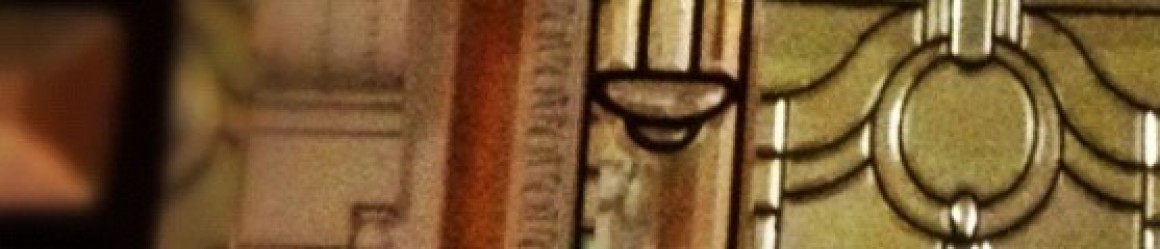
I went to a concert at the Royal Conservatory of Music in Toronto the other week and came across a fine example of one of my fascinations: a walking stick flute. I am a baroque flautist and I use a walking stick, so perhaps it comes as no surprise to hear that I am a fan. We took a photo.

Are walking stick flutes unusual? A little, but once you start spotting them in musical instrument collections and museums (for example, the Horniman Museum, the Metropolitan Museum and the Germanisches Nationalmuseum) it becomes apparent that once upon a time they were all the rage. I’m yet to play one but I can’t think of anything more charming: first it props you up, then when you reach your destination you can play a merry tune. Perfect.

My fascination has been purely whimsical, until recently when I was fortunate to join a team of researchers lead by Dr John Chu investigating a painting that hangs in Tate Britain. Thomas Gainsborough’s Peter Darnell Muilman, Charles Crokatt and William Keable in a Landscape c.1750 depicts three gentlemen in a pastoral setting, and the central figure, Keable, is playing the transverse, baroque, flute. It is an indication of the great popularity of this musical instrument amongst English gentlemen of the mid eighteenth century and my job was to investigate the specifics of the flute that William Keable was playing. A fascinating journey ensued which led me to unpublished manuscripts and a reproduction of the instrument in the portrait – which I play on a recording that will accompany the publication. However, the matter of walking stick flutes came up as soon as I saw this merry trio.

You will see that all three gentlemen in the portrait carry either a flute or walking cane and the way they were arranged immediately caught my eye. The cane in Muilman’s hands (the chap on the far left) almost looks like a flute and prompted me to ask whether it was originally ever intended to be an instrument. I wondered whether the awkward position of his left hand might even suggest a re-working of this detail of the portrait when turning the flute into a walking stick. Whether or not this was the case, a switch would be no coincidence: it has been said that the fashion for walking stick flutes in the eighteenth century ‘permeated masculine leisure’ and the flute could also be found incorporated into swordsticks and – particularly in England – umbrellas.[1]

Walking sticks could in fact contain all manner of curiosities – from telescopes, pedometers, and quill pens with ink and paper, to instruments such as violins, flutes, clarinets, mouth organs, and banjos. Their popularity was seen across all ranks of European gentry as a practical and essential accessory for outdoor pursuits – and was not restricted to the wealthy: ‘Rousseau, who was considered a poor man is said to have purchased forty sticks; and Voltaire, who was not a follower of fashion, owned eighty’.[2] Where a portrait is concerned, being shown playing, rather than posing with the flute is rare, but the walking sticks make the whole scene even more macho. After all, the flute was a man’s instrument at this time. It was considered quite improper for the eighteenth-century lady – she was persuaded that to play it would take away ‘too much of the Juices, which are otherwise more necessarily employ’d, to promote the Appetite, and assist Digestion’.[3]

So there we go. I’ll add a link to the research when it is published on the Tate Research site. In the meantime, I like the idea of surprises inside my walking stick. It’s the kind of every-day magic I aspire to. And I’ll take the risk on my digestive juices.


[1]Ardal Powell, The Flute, New Haven and London 2002, p.144.

[2]Katherine Lester and Bess Viola Oerke, Accessories of Dress: An Illustrated Encyclopaedia, London 2004, p. 396.

[3]John Essex, The Young Ladies Conduct: or, Rules for Education, Under Several Heads, London 1722, p. 85.
Brexit and the Last Night of the Proms – Look Forward by Looking Back

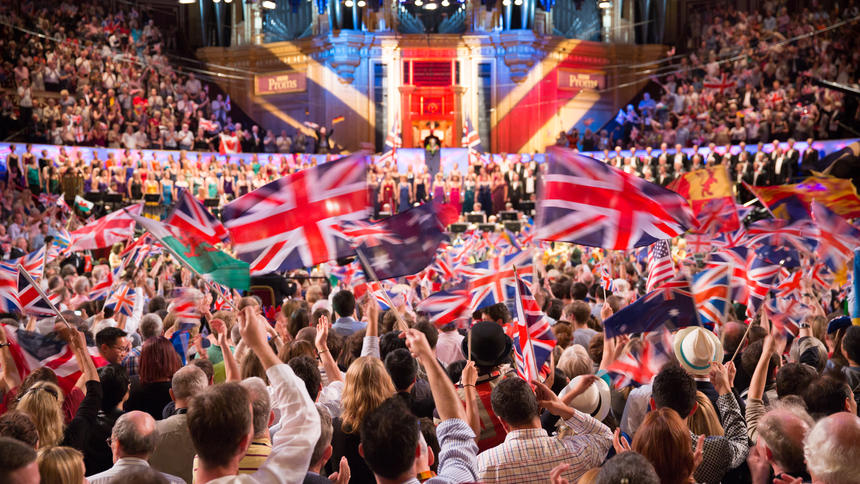
We just celebrated our first Canada Day as a family in Toronto. We dressed up in so much Canadiana we were a vision in red, white, and maple – and out here that’s cool. If you did the same with the Union Flag, I’m not sure you would capture the same tone, certainly not right now. Which leads me to thinking about the most flag-waving event in my British calendar: The Last Night of the Proms. For many years it has trodden a bit of a fine line in nationalistic taste, but I fear for the evening in a post-Brexit referendum year.

The thought of it leaves me feeling a bit queasy, especially as earlier this year I wrote a feature for the night’s Proms Guide on Parry’s Jerusalem. It’s 100 years since Parry set Blake’s poem but I’m not convinced that there’s much ‘green and pleasant’ going on across the land just now.

For consolation I’ve had a look back to Henry Wood’s Last Night. Yes, the whole Prom season was always an intense expression of Englishness (not even necessarily Britishness) – the National Anthem was sung each night. But Wood and co-founder/impresario Robert Newman were passionate about inclusivity, promoting new works and artists from across the continent. Remember too that they stood firm on allowing German repertoire to be performed during both world wars, and included not only the national anthems of the allies throughout the war-time seasons but also hung allied flags around the organ.

The original point of the Last Night was to celebrate the season and bid farewell until the next year. I think we sometimes forget that until the 1927 the entire festival was performed by one orchestra, the Queen’s Hall Orchestra, under one conductor, Henry Wood. When the BBC took over, the BBC Symphony Orchestra served the Proms and eventually Wood was assisted by Basil Cameron and Adrian Boult, but until his death in 1944 the principle was the same: one band, one conductor. The musicians and Prommers became one big musical family and Wood recalled how strong the feeling was on the Last Night as a result:

The Ritual of the Last Prom of the Season is now established. It is a gala night and the young Promenader is determined not to take his music too seriously. Even so, he listens as intently as ever to the first part of the programme. As each leader of the various orchestra sections takes his place he is greeted with a round of applause; even the attendant who opens the lid of the piano is recognized and similarly applauded. The Principal Violin, that night, receives almost as much applause as I do on other nights, whereas my own welcome is something I can never quite get used to, even after all these years. The scenes at the end must strike any one witnessing the for the first time as being unique. (Wood, My Life of Music, p. 191)

So, did they have flag waving and communal singing in those early days? Not exactly. Initially, besides the National Anthem, the Last Night was all about showcasing the soloists in the orchestra, but the party atmosphere really started in 1906 with what Wood described as the ‘sea business’.

I little dreamed when I arranged this item [Fantasy on British Sea Songs]– merely to finish a programme for a special occasion – that the Promenade public would demand its repetition on the last night of the season for ever afterwards, As it had proved a success at the original centenary concert I put it down for the last night of the season following – just to see how it would go. One year I thought we had had enough of it and left it out, but on the Monday morning I received so many letters of protest and disappointment that I resolved never to omit it again. The younger Promenaders thoroughly enjoy their part in it. They stamp their feet in time to the hornpipe – that is until I whip up the orchestra in a fierce accelerando which leaves behind all those whose stamping technique is not of the very first quality. I like to win by two bars, if possible, but sometimes have to be content with a bar and a half. It is good fun, and I enjoy it as much as they. When it comes to the singing of Rule Britannia! We reach a climax that only Britons can reach and I realize I can be nowhere in the world but in my native England. (Wood, My Life of Music, pp. 191-2)

Context is everything. This is what makes me uneasy about the tone this year – I hope that the Last Night can dig deep to its roots and remain a celebration of the music and musicians rather than a spectacle of uneasy nationalism. Jerusalem came much later, which I’ll blog about later this summer.

What of the speech? Wood was uncomfortable with public speaking, and for him the Last Night was all about the music. The first real speech was necessitated by the War. The home of the Promenades, the Queen’s Hall, was bombed in the 1941 (the same night as the Houses of Parliament) and the following year the Proms moved to the Royal Albert Hall. Wood wanted to thank the Prommers for their support and reassure them that the show would go on, but his speech was such a success that Lady Jessie Wood persuaded him to repeat it each year after. Malcolm Sargent was much more keen on the idea and the Last Night speech gained much more momentum during his tenure.

Maybe there is one more thing that could be done. I notice that the Canadians have included the Chorale from Beethoven’s Ninth Symphony, Ode to Joy, in their Almost Last Night of the Proms finale to the London Calling Summer Festival 2016 in Toronto. As the anthem of the European Union, perhaps this might be a fitting addition to the real Last Night programme – at least for the next two years… Then choose your own context: unity, nostalgia, tribute to our membership, or respect for our closest neighbours and friends.

Photo Credits RAH Archive