A Day at the Museum: The Frick Collection, New York

On 2 May the Frick Collection in New York was closed to the public. However, BBC Producer Les Pratt and I had the special privilege of being allowed in to make four Lunchtime Concerts and an episode of the Early Music Show for Radio 3. Being let loose in the galleries I was reminded of the film trilogy Night at the Museum in which an ancient curse causes animals and exhibits on display to come to life after hours. Well, there was no ancient curse at work here but the works of art certainly came to life with characters, scenes, and stories that made for an unforgettable day.

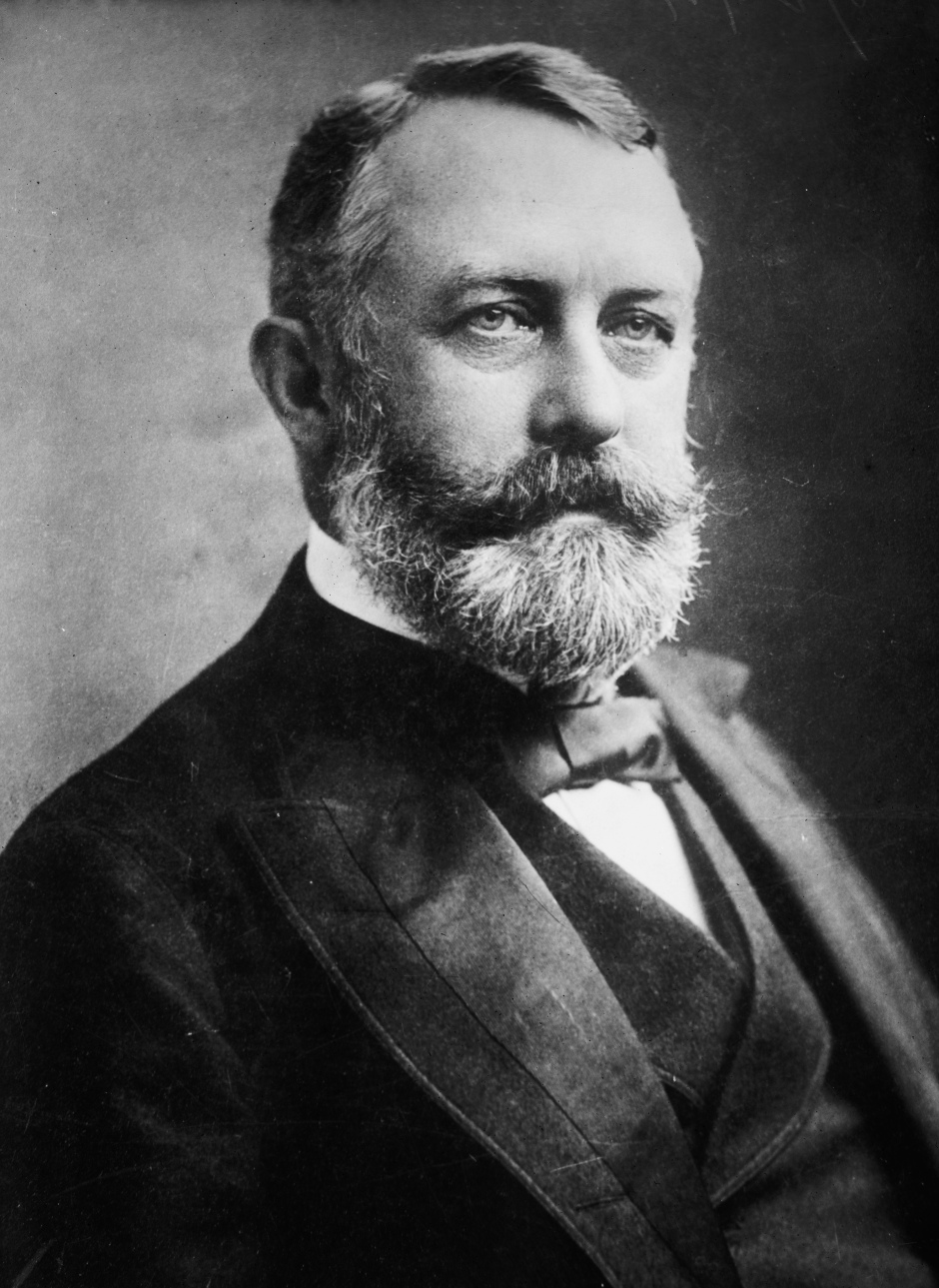
The Frick Collection is a beautiful mansion found to the East of Central Park, just off Fifth Avenue. It was built by Henry Clay Frick, who was one of America’s most successful coke and steel industrialists, and also an avid art collector. On his death in 1919 his wealth of paintings and sculptures, from Titian and Bellini to Degas and Turner, were bequeathed to the public. Naturally there is a magnificent music room and it has staged a regular series of chamber music concerts since 1938.

Joyce Bodig, Frick Concerts Coordinator since 1983, let us into this oasis of tranquility. She is a woman with a keen musical ear and clearly knows how to throw a splendid party in addition to a classy concert. Since its inauguration, the Concert Series has played host to a veritable Who’s Who of the music world and especially the early music world. The Music Room is a vision of grandeur from a bygone time; light fills the damask-papered walls from the elegant central dome. TS Eliot read from his poems here but if walls could talk, or sing or play, we can only imagine the secrets they would tell alongside sounds of performances not recorded. The archives are a treasure trove. My old PhD hat went on immediately as characters I’ve written about in London from the Busch Quartet to Artur Schnabel, and Ralf Kirkpatrick to Isaac Stern, Alfred Brendel, and Wanda Landowska, popped up across the pond.

In a lifetime, how often do you get a private wander around a priceless art collection? More than that, how many times are you accompanied by the Chief Curator who brings each piece to life, giving you insights you would never have otherwise noticed? Peter Jay Sharp Chief Curator Xavier Salomon is a seriously sophisticated man with that enviable skill of captivating an audience with little known details. I was totally hooked. Half the time I forgot I was working I was so absorbed in what he was saying (cue lots of retakes on my part).

Music features heavily throughout the collection and the characters on the walls seemed to demand accompaniment. Take for example, Vermeer’s portrait Girl Interrupted at her Music: is the male figure her teacher or her lover? Xavier counselled us to look to the picture within the picture and let Cupid help you decide. Painted in the year of Purcell’s birth what could be more appropriate than the depiction of Cupid from the Restoration spectacular King Arthur? Cue Anne Sofie Von Otter, accompanied by the lute and harpsichord of Thomas Dunford and Jonathan Cohen.

I’ve always been fascinated by the art that composers might have seen and was part of their cultural aesthetic. For instance, Degas’ intricate work The Rehearsal – a juxtaposing old and young, music and movement, (and the humour of a seemingly dismembered dancer’s leg), was likely known to Debussy as he often visited the home of painter, collector, and patron Henry Lerolle. Debussy is of course associated with the Impressionist school despite it being a term that he didn’t like, but hearing his demanding sonata cello and piano exemplified his artistry in the hands of Nicolas Altstaedt and Alexander Lonquich.

It was as if the portraits on the walls were presiding over the music wherever we went and in an almost Hogwartian fashion oversaw the musical examples. Whether Holbein’s two Thomases: Cromwell and More glowering at each other over the fireplace (Frick as architect of this), or the knowing look of Van Dyke’s portrait of musician, poet, and composer Nicholas Lanier, the concert performances not only of von Otter and Altstaedt., but also the Minetti Quartet and Flanders Recorder Quartet, fuelled the imagination.

And the encounters kept coming. Wanda Landowska was a regular Frick performer between 1943 and 1954 and she always insisted on a huge, and particularly heavy, lamp on stage to light her music. In a moment of mutual discovery during our visit, the lamp was identified in Xavier’s office. The shade had been changed but Joyce had a feeling she knew where it might be. The place is just bursting with musical and artistic history.

Recording the final links in the library, under the watchful eye of Frick’s own portrait, my eyes hungrily scanned the walls for paintings we’d not had time to look at – masterpieces by Turner, Constable, and Gainsborough alongside exquisite works of artists I still need to learn about.

On leaving, a final glance back into stillness of the beautiful inner courtyard garden reaffirmed my overwhelming impression of the place – it could have been just as Frick left it.
Tales of Two Cities

Tafelmusik, Trio Arabica, Alon Nashman

Saturady 21 May, Koerner Hall, Toronto


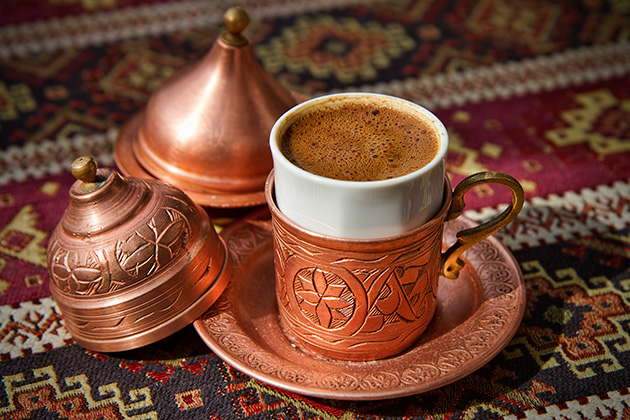
Come into the coffee house

Where divine goodness favours those who share in its bounty.

The sweetness of life, the company of friends, the elegance of rugs –

These make it the abode of the blest.

For coffee is the source of our health,

The fire which consumes our grief,

And the steam which washes away our sorrow!                                

Sixteenth-Century Arabic Poem


There are good concerts, and excellent concerts, and then every now and then there is a concert that is utterly transporting. Tafelmusik’s Tales of Two Cities was one such event.

The latest multimedia brainchild of double-bassist Alison Mackay, links the eighteenth-century cities of Leipzig and Damascus through music, literature, and art. Each at the crossroads of trade routes, the connections between the two turn out to be far-reaching, fundamental, and above all, poetic. Whether through coffee, ceramics, inks, papers, libraries, poets, or musicians, the two cities emerge as hotspots of cultural beauty and the meeting of storytelling, education, and ideas.

In lesser hands, the evening could have been an elaborate powerpoint presentation to accompany a concert – but this could not have been farther from the truth. Mackay’s conception, programme and script was a class production in the hands of Stage Director Marshall Pynkoski, Production Designer Glenn Davidson, and Projections Designer Raha Javanfer. Tafelmusik were joined by Trio Arabica and narrator-actor Alon Nashman – who with Trio Arabica’s Maryem Tollar, wove a tale of enlightenment from coffee houses to courts. Again, the result could have been an awkward fusing of music from east and west, but the gradual crossover of individuals – such as the percussion in Telemann’s Overture in D, or fiddle in Oud Taksim – meant you were holding out for the two bands to unite in the celebratory finale.

Visually, it was stunning. From reconstructed intricate Damascene panelling to detail from coffee mugs, or portraits of characters looking down on the musicians, the backdrop screen seamlessly accompanied the musical programme and subtly coloured the narrative or educated on necessary geographical features. And, judging the pace and tone perfectly, narrator Alon Nashman flitted between biographies, witticisms, and straight-talking information to explain or elaborate on what would otherwise have been an eclectic programme. He brought a sense of smell to the proceedings – from the strength of various coffees, to jasmine, roses, and bitter orange.

But above all the assault on the senses was aural. From the melodies of Leipzig’s coffee houses and the scholars of Telemann and Handel, to the Ambassadors educated by Lully’s music of the French Court, Italian Concertos and scenes from Don Quixote, Tafelmusik were on top form, with solo outings from practically every member of the band. Within these, Trio Arabica inlayed jewels from their repertoire. I found myself holding my breath during Maryem Tollar’s bewitching performance of Sheikh Abul Ela Mohamed’s “Afdihi in Hafidhal Hawa Ow Diya’a”, and the sounds of every level of Damascene society were depicted by the trio, including the astonishing virtuosity of Naghmeh Farahmand’s solo percussion. The music was frankly spellbinding and so constantly evolving that by the end you could almost hear the eastern touches in Bach.

Perhaps the most striking element of the presentation was that every musician on stage performed from memory. For soloists this may be de rigeur but the full programme was a huge undertaking for all the middle parts and accompaniments. I knew in advance that this was their thing and expected it to make a difference to the communication both with each other and the audience, but the overall effect was so profound I was blown away. The freedom that came from ridding the stage of music stands was fundamental. Whether placing musicians around the superb acoustics of Koerner Hall or the flexibility on stage which allowed for myriad formations, or the manner in which they simply milled about whilst playing. Characterization was another unexpected result of memorization as instrumentalists took on the roles of Pisendel or Jewish fiddlers, just as Trio Arabica became Scheherazade or members of a coffee house band.

But most of all, memorization made sense of small-scale phrasing – a moment for a trio, or a middle part melody that jumps out of the texture. And at the point that you felt they were all having a lovely time conversing with each other on stage, you would notice that they were all looking and playing out – they had not lost their audience. To pull this off with the precision they achieved was, without doubt, the direction of Jeanne Lemon. Understated but sparkly, her gestures and glances cast across the stage brought the ensemble to life – and that’s the Tafelmusik way: a family who share musical responsibility, give each other room to shine, but ultimately have an eye and ear on their director. There’s alchemy in there.

Tales of Two Cities was one of those events that you could sit back and enjoy on any level but the culmination brought the focus to the current plight of Syrian refugees. Emphasizing the deep cultural  exchange that comes from welcoming families from the war-torn region reflected the history of migration and was an intense message for today. A blog like this can’t begin to chart the research undertaken (especially by Dr. Anke Scharrahs, Tafelmusik’s scholar in residence for the project) or the layers of meaning portryed. However, you didn’t have to know about period or middle-eastern performance practice or European and Arabic literature to be moved by the core message, the visual beauty, the musical refinement, or the humour of the show. However, I’d bet that most of the audience felt as I did as we left: you wanted to be a part of it and spent the rest of the holiday weekend finding out more.

Tales of Two Cities was developed in a residency at Isabel Bader Centre for the Performing Arts at Queen’s University in Kingston, and in collaboration with the Aga Khan Museum.

http://www.tafelmusik.org/concert-calendar/concert/tales-two-cities-leipzig-damascus-coffee-house